On Democracy by Robert A. Dahl
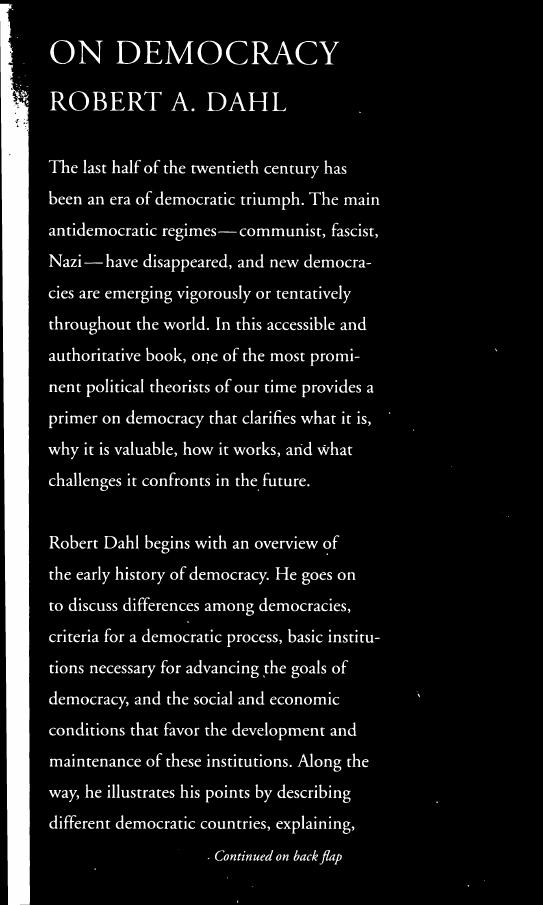
Author:Robert A. Dahl
Language: eng
Format: epub, pdf
Publisher: Yale University Press
Published: 2017-04-15T04:00:00+00:00
HOW CONSTITUTIONS MAKE A DIFFERENCE
Constitutions might matter to a country’s democracy in many ways.
Stability. A constitution might help to provide stability for the basic democratic political institutions described in Chapter 8. It could not only lay down a democratic framework of government but also insure all the necessary rights and guarantees that the basic political institutions require.
Fundamental rights. A constitution might protect majority and minority rights. Even though this criterion is implicitly included in the first, because of variations among democratic constitutions it is useful to give special attention to the basic rights and duties that provide guarantees for both majorities and minorities.
Neutrality. A constitution could maintain neutrality among the country’s citizens. Having insured fundamental rights and duties, the constitutional arrangements could also insure that the process of making laws is designed neither to favor nor to penalize the views or the legitimate interests of any citizen or group of citizens.
Accountability. The constitution could be designed to enable citizens to hold political leaders accountable for their decisions, actions, and conduct within a “reasonable” interval of time.
Fair representation. What constitutes “fair representation” in a democracy is the subject of endless controversy, in part because it bears on the next two criteria.
Informed consensus. A constitution might help citizens and leaders to develop an informed consensus on laws and policies. It could do so by creating opportunities and incentives for political leaders to engage in negotiations, accommodation, and coalition building that would facilitate the conciliation of diverse interests. More about this in the chapters to come.
Effective government. By effectiveness I mean that a government acts to deal with what citizens understand to be the major issues and problems they confront and for which they believe government action is appropriate. Effective government is particularly important in times of great emergency brought on by war, the threat of war, acute international tension, severe economic hardship, and similar crises. But it is also relevant in more ordinary times, when major issues head the agendas of citizens and leaders. To be sure, in the short run a nondemocratic government might sometimes meet this criterion better than a democratic government; though whether it would do so in the long run seems more doubtful. In any case, we are concerned with governments functioning within democratic limits. Within those limits, it seems reasonable to want a constitutional system that has procedures to discourage protracted deadlock, delay, or evasion in confronting major issues and encourage taking action to deal with them.
Competent decisions. Desirable as effective government may be, we would hardly admire a constitution that facilitates decisive and resolute action yet makes it hard for a government to draw on the best knowledge available for solving the urgent problems on the country’s agenda. Decisive action is no substitute for wise policy.
Transparency and comprehensibility. By this pair of criteria I mean that the operation of the government is sufficiently open to public view and simple enough in its essentials that citizens can readily understand how and what it is doing. Thus it
Download
This site does not store any files on its server. We only index and link to content provided by other sites. Please contact the content providers to delete copyright contents if any and email us, we'll remove relevant links or contents immediately.
| Anthropology | Archaeology |
| Philosophy | Politics & Government |
| Social Sciences | Sociology |
| Women's Studies |
The Secret History by Donna Tartt(19086)
The Social Justice Warrior Handbook by Lisa De Pasquale(12190)
Thirteen Reasons Why by Jay Asher(8909)
This Is How You Lose Her by Junot Diaz(6886)
Weapons of Math Destruction by Cathy O'Neil(6279)
Zero to One by Peter Thiel(5801)
Beartown by Fredrik Backman(5754)
The Myth of the Strong Leader by Archie Brown(5507)
The Fire Next Time by James Baldwin(5442)
How Democracies Die by Steven Levitsky & Daniel Ziblatt(5218)
Promise Me, Dad by Joe Biden(5153)
Stone's Rules by Roger Stone(5087)
A Higher Loyalty: Truth, Lies, and Leadership by James Comey(4962)
100 Deadly Skills by Clint Emerson(4925)
Rise and Kill First by Ronen Bergman(4788)
Secrecy World by Jake Bernstein(4753)
The David Icke Guide to the Global Conspiracy (and how to end it) by David Icke(4717)
The Farm by Tom Rob Smith(4507)
The Doomsday Machine by Daniel Ellsberg(4490)
